Digital Twin for Cryogenic Ejector Systems: Integrating Advanced Machine Learning and Dynamic Modeling
DOI:
https://doi.org/10.58190/imiens.2025.154Keywords:
Digital Twin, Cryogenic Ejector, Boil-Off-Gas (BOG), Machine Learning, Physics-Informed Neural Networks (PINN)Abstract
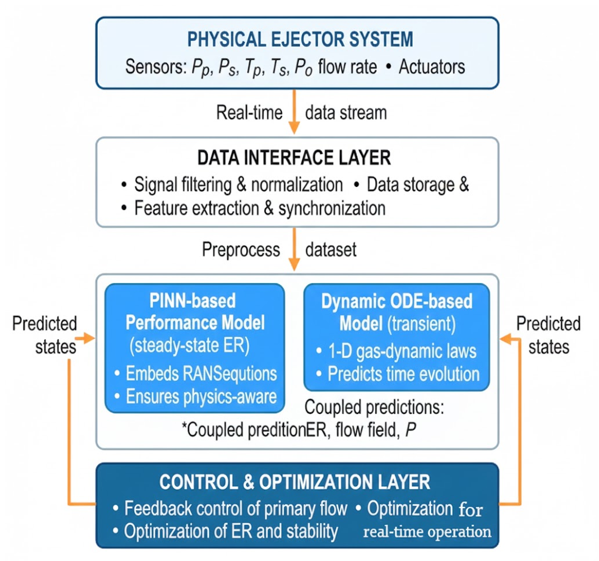
This paper presents an integrated Digital Twin (DT) framework for cryogenic ejector systems designed for Boil Off Gas (BOG) management in Liquefied Natural Gas (LNG) applications. Building on prior experimental and numerical studies, the proposed DT improves both predictive accuracy and dynamic adaptability by coupling Physics Informed Neural Networks (PINNs) with a transient dynamic model. The PINN integrates compressible flow conservation laws into its loss function, ensuring physical consistency during learning. A dataset of 1000 operating points was analyzed, revealing that the primary pressure (Pp) is the dominant factor influencing the entrainment ratio (ER). A baseline linear regression achieved an R2 equal to 0.791, while the PINN increased predictive accuracy to an R2 equal to 0.98. The dynamic model simulates the transient response of the ejector to sudden variations in BOG load, demonstrating the DT capability to anticipate system instability and enable real time control. Together, these components create a physically interpretable and computationally efficient digital framework capable of supporting the design, optimization, and operation of cryogenic ejectors. The results highlight the potential of the proposed DT to enhance energy efficiency, reliability, and safety in LNG processing systems through intelligent, physics based decision making.
Downloads
References
[1] H. Samsam-Khayani, S. Y. Yoon, M. Kim, and K. C. Kim, "Experimental and numerical study on low-temperature supersonic ejector," Int. J. Thermofluids, vol. 20, p. 100407, 2023 , doi: 10.1016/j.ijft.2023.100407.
[2] F. Perez et al., "Measurements of boil-off gas and stratification in cryogenic liquid nitrogen with implications for the storage and transport of liquefied natural gas," Energy, vol. 222, p. 119853, 2021, doi: 10.1016/j.energy.2021.119853
[3] G. Shu, B. Liu, H. Tian, L. Li, R. Sun, and X. Wang, "A cryogenic CO2 capture system coupled with boil-off gas re-liquefaction for LNG carriers," Sep. Purif. Technol., vol. 362, p. 131783, 2025, doi: 10.1016/j.seppur.2025.131783.
[4] D. Sun, C. Wang, and Q. Shen, "A compression-free re-liquefication process of LNG boil-off gas using LNG cold energy," Energy, vol. 294, p. 130894, 2024, doi: 10.1016/j.energy.2024.130894.
[5] M. Mhiri et al., "Enhancing liquefied natural gas supply chain robustness through digital twin-driven machine learning models: A special case of cryogenic heat exchanger," Gas Sci. Eng., p. 205714, 2025, doi: 10.1016/j.jgsce.2025.205714.
[6] C. Oliet et al., "Thermal digital twin of LH₂ aircraft storage tank," Eng. Proc., vol. 90, no. 1, p. 97, 2024, doi: 10.3390/engproc2025090097.
[7] Y. Wu, G. Yang, J. Sun, L. Cui, and M. Wang, "Digital twin modeling and leak diagnosis of temperature and stress fields in LNG storage tanks," Measurement, vol. 228, p. 114374, 2024, doi: 10.1016/j.measurement.2024.114374.
[8] R. Mao et al., "Rapid CFD prediction based on machine learning surrogate model in built environment: A review," Fluids, vol. 10, no. 8, p. 193, 2025, doi: 10.3390/fluids10080193.
[9] Y. Bartosiewicz, Z. Aidoun, and P. Desevaux, "Numerical and experimental investigations on supersonic ejectors," Int. J. Heat Fluid Flow, vol. 26, no. 1, pp. 56–70, 2005, doi: 10.1016/j.ijheatfluidflow.2004.07.003.
[10] X. Chen et al., "Inlet temperature-dependent performance prediction via a physics-informed neural network and flow mechanism analysis in a multistage dense-phase CO₂ pump," Phys. Fluids, vol. 37, no. 9, 2024, doi : 10.1063/5.0282032.
[11] Z. Cao, K. Liu, K. Luo, Y. Cheng, and J. Fan, "Efficient optimization design of flue deflectors through parametric surrogate modeling with physics-informed neural networks," Phys. Fluids, vol. 36, no. 1, 2023, doi : 10.1063/5.0180594.
[12] C. Li, J. Fu, Y. Huang, and X. Sun, "Experimental analysis and physics-informed optimization algorithm for ejector in fuel cells based on boundary-breaking and dimension reduction," Renew. Energy, vol. 237, p. 121756, 2024, doi : 10.1016/j.renene.2024.121756.
[13] L. Yin, M. Qi, X. Xie, and Y. Ju, "Exploring the process robustness and dynamic response of directly Re-liquefying BOG using subcooled LNG," Energy, vol. 316, p. 134513, 2025, doi : 10.1016/j.energy.2025.134513.
[14] J. Connolly, G. Kopasakis, D. Paxson, and E. Stuber, "Nonlinear dynamic modeling and controls development for supersonic propulsion system research," in Proc. 47th AIAA/ASME/SAE/ASEE Joint Propulsion Conf. Exhibit, 2011, Art. no. 5635, doi : 10.2514/6.2011-5635.
[15] S. P. Singh et al., "Data-driven modeling to predict the rate of boil-off gas (BOG) generation in an industrial LNG storage tank," in Comput. Aided Chem. Eng., vol. 52, 2024, pp. 1293–1299, doi : 10.1016/B978-0-443-15274-0.50206-7.
[16] Y. Wu, G. Yang, J. Sun, L. Cui, and M. Wang, "Digital twin modeling and leak diagnosis of temperature and stress fields in LNG storage tanks," Measurement, vol. 228, p. 114374, 2024, doi: 10.1016/j.measurement.2024.114374.
[17] Z. Liu, M. Babaei, C. C. Song, and C. Zhang, "Pumps for Digital Twin Simulations," in Digital Twin Computing for Urban Intelligence, 2024, p. 119.
[18] Y. A. Sazonov, M. A. Mokhov, A. V. Bondarenko, V. V. Voronova, K. A. Tumanyan, and E. I. Konyushkov, "Investigation of a multiflow ejector equipped with variable-length links for thrust vector control using Euler’s methodology," Eng, vol. 5, no. 4, pp. 2999-3022, 2024, doi: 10.3390/eng5040156.
[19] W. Kang, H. Zhang, D. Hu, L. Jia, H. Xue, and W. Sun, "Experimental and transient numerical study of pressure fluctuations at ejector ports," Appl. Therm. Eng., p. 127461, 2025, doi : 10.1016/j.applthermaleng.2025.127461.
[20] K. Shi, R. Han, Z. Li, and P. Guo, "Construction concrete price prediction based on a double-branch physics-informed neural network," Buildings, vol. 15, no. 13, p. 2171, 2025, doi: 10.3390/buildings15132171.
[21] H. Yan et al., "Smart control of bridge support forces using adaptive bearings based on physics-informed neural network (PINN)," Autom. Constr., vol. 168, p. 105790, 2024, doi: 10.1016/j.autcon.2024.105790.
[22] S. Plankovskyy, Y. Tsegelnyk, N. Shyshko, I. Litvinchev, T. Romanova, and J. M. Velarde Cantú, "Review of physics-informed neural networks: Challenges in loss function design and geometric integration," Mathematics, vol. 13, no. 20, p. 3289, 2025, doi: https://doi.org/10.3390/math13203289.
[23] I. Pietrangeli, G. Mazzuto, F. E. Ciarapica, and M. Bevilacqua, "Artificial Neural Networks approach for Digital Twin modelling of an ejector," in Proc. 35th Eur. Model. Simul. Symp., Athens, Greece, Sep. 2023, pp. 18-20, doi: 10.46354/i3m.2023.emss.007.
Downloads
Published
Issue
Section
License
Copyright (c) 2025 Intelligent Methods In Engineering Sciences

This work is licensed under a Creative Commons Attribution-ShareAlike 4.0 International License.
How to Cite