CrackNet: Pavement Crack Detection and Classification Based on Deep Learning Models
DOI:
https://doi.org/10.58190/imiens.2025.152Keywords:
Deep learning, MobileNet, SqueezeNet, InceptionV4, Fracture detection, Crack detectionAbstract
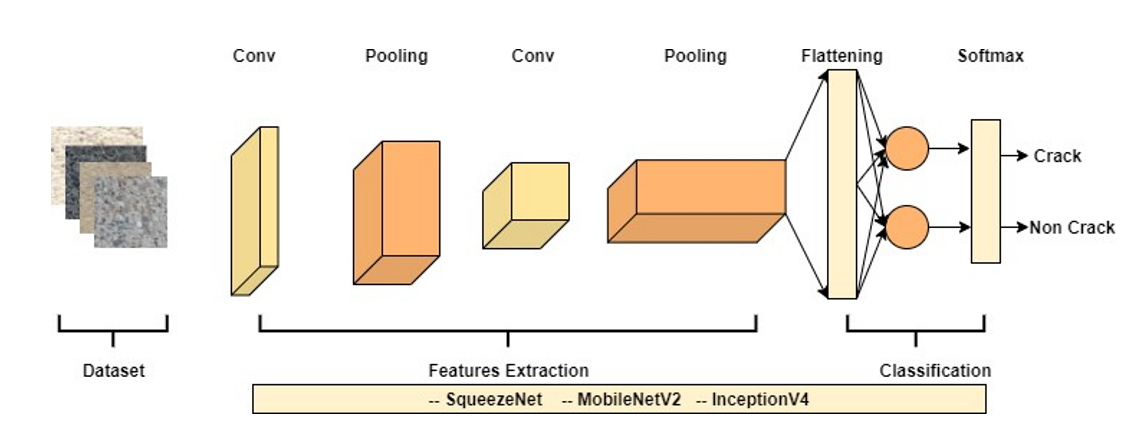
The identification of pavement cracks is essential for reducing traffic accidents and minimizing road maintenance costs. Existing crack detection methods frequently encounter challenges related to inefficiencies and accuracy, resulting in billions of dollars spent globally on road repairs annually. This study introduces an enhanced deep learning-based network aims at improving the accuracy of pavement crack detection. The proposed CrackNet utilizes advanced geometric augmentation techniques to enhance the model performance in identifying cracks across a variety of road conditions. We introduced CrackNet, a custom-designed deep-learning classification framework for pavement images. CrackNet combines pre-trained backbone feature extractors (MobileNetV2, InceptionV4, SqueezeNet) with a lightweight classifier head and a comprehensive preprocessing + augmentation pipeline to improve generalizability and address class imbalance. We evaluated three CrackNet variants (Sqz-CrackNet, Mob-CrackNet, Incep-CrackNet), each distinguished by its backbone, and found Incep-CrackNet achieved the highest accuracy of 96.05%, surpassing the Mob-crackNet and Sqz-crackNet, which attained accuracies of 95.44% and 90.06%, respectively. These findings underscore the effectiveness of the proposed deep learning framework in accurately detecting pavement cracks, representing a significant advancement over traditional detection methods.
Downloads
References
[1] L. Zhang, G. Zhou, Y. Han, H. Lin, and Y. Wu, “Application of Internet of Things Technology and Convolutional Neural Network Model in Bridge Crack Detection,” IEEE Access, vol. 6, pp. 39442–39451, 2018, doi: 10.1109/ACCESS.2018.2855144.
[2] V. Mandal, L. Uong, and Y. Adu-Gyamfi, “Automated Road Crack Detection Using Deep Convolutional Neural Networks,” in Proc. 2018 IEEE Int. Conf. on Big Data (Big Data), 2018, pp. 5212–5215, doi: 10.1109/BigData.2018.8622327.
[3] S. S. N. Sheerin, S. Kavitha, and G. Raghuraman, “Review and Analysis of Crack Detection and Classification Techniques Based on Crack Types,” International Journal of Applied Engineering Research, vol. 13, no. 8, pp. 6056–6062, 2018, doi: 10.37622/IJAER/13.8.2018.6056-6062.
[4] M. Maguire, S. Dorafshan, and R. J. Thomas, “Structural Defects Network (SDNET) 2018,” Kaggle dataset, 2018. [Online]. Available: https://www.kaggle.com/datasets/aniruddhsharma/structural-defects-network-concrete-crack-images
[5] A. Raza, M. U. Khan, Z. Saeed, S. Samer, A. Mobeen, and A. Samer, “Classification of eye diseases and detection of cataract using digital fundus imaging and Inception-V4,” in Proc. Int. Conf. on Frontiers of Information Technology (FIT), 2021, pp. 137–142.
[6] Z. Saeed, M. U. Khan, A. Raza, H. Khan, J. Javed, and A. Arshad, “Classification of pulmonary viruses X-ray and detection of COVID-19 based on invariant of Inception-V3 deep learning model,” in Proc. 2021 Int. Conf. on Computing, Electronic and Electrical Engineering (ICE Cube), Quetta, Pakistan, 2021, pp. 1–6, doi: 10.1109/ICECube53880.2021.9628338.
[7] M. U. Khan, M. A. Abbasi, Z. Saeed, M. Asif, A. Raza, and U. Urooj, “Deep learning-based intelligent emotion recognition and classification system,” in Proc. 2021 Int. Conf. on Frontiers of Information Technology (FIT), Islamabad, Pakistan, 2021, pp. 25–30, doi: 10.1109/FIT53504.2021.00015.
[8] Z. Saeed, O. Bouhali, J. X. Ji, R. Hammoud, N. Al-Hammadi, S. Aouadi, and T. Torfeh, “Cancerous and non-cancerous MRI classification using dual DCNN approach,” Bioengineering, vol. 11, no. 5, p. 410, 2024.
[9] M. U. Khan, Z. Saeed, A. Raza, Z. Abbasi, S. Z. E. Z. Ali, and H. Khan, “Deep learning-based decision support system for classification of COVID-19 and pneumonia patients,” Journal on Advanced Research in Electrical Engineering (JAREE), vol. 6, no. 1, 2022.
[10] S. Z. H. Naqvi, M. U. Khan, A. Raza, Z. Saeed, Z. Abbasi, and S. Z. E. Z. Ali, “Deep learning-based intelligent classification of COVID-19 and pneumonia using cough auscultations,” in Proc. 2021 6th Int. Multi-Topic ICT Conf. (IMTIC), Jamshoro and Karachi, Pakistan, 2021, pp. 1–6, doi: 10.1109/IMTIC53841.2021.9719740.
[11] U. Nawaz, M. Anees-ur-Rahaman, and Z. Saeed, “A review of neuro-symbolic AI integrating reasoning and learning for advanced cognitive systems,” Intelligent Systems with Applications, vol. 26, p. 200541, 2025, doi: 10.1016/j.iswa.2025.200541.
[12] Z. Saeed, M. U. Khan, A. Raza, N. Sajjad, S. Naz, and A. Salal, “Identification of leaf diseases in potato crop using deep convolutional neural networks,” in Proc. 2021 16th Int. Conf. on Emerging Technologies (ICET), Islamabad, Pakistan, 2021, pp. 1–6, doi: 10.1109/ICET54505.2021.9689807.
[13] Z. Saeed, A. Raza, A. H. Qureshi, and M. H. Yousaf, “A multi-crop disease detection and classification approach using CNN,” in Proc. 2021 Int. Conf. on Robotics and Automation in Industry (ICRAI), Rawalpindi, Pakistan, 2021, pp. 1–6, doi: 10.1109/ICRAI54018.2021.9651409.
[14] Z. Saeed, M. H. Yousaf, R. Ahmed, S. A. Velastin, and S. Viriri, “On-board small-scale object detection for unmanned aerial vehicles,” Drones, vol. 7, no. 5, p. 310, 2023, doi: 10.3390/drones7050310.
[15] A. Ishtiaq, Z. Saeed, M. U. Khan, A. Samer, M. Shabbir, and W. Ahmad, “Fall detection, wearable sensors and artificial intelligence: A short review,” Journal on Advanced Research in Electrical Engineering (JAREE), vol. 6, no. 2, 2022.
[16] A. Raza, Z. Saeed, A. Aslam, S. M. Nizami, K. Habib, and A. N. Malik, “Advances, applications, and challenges of lithography techniques,” in Proc. 2024 5th Int. Conf. on Advancements in Computational Sciences (ICACS), Lahore, Pakistan, 2024, pp. 1–6, doi: 10.1109/ICACS60934.2024.10473245.
[17] Z. Saeed, M. N. M. Awan, and M. H. Yousaf, “A robust approach for small-scale object detection from aerial-view,” in Proc. Int. Conf. on Digital Image Computing: Techniques and Applications (DICTA), 2022, pp. 1–7.
[18] U. Nawaz, Z. Saeed, and K. Atif, “A novel transformer-based approach for adult facial emotion recognition,” IEEE Access, vol. 13, pp. 56485–56508, 2025, doi: 10.1109/ACCESS.2025.3555510.
[19] L. Zhang, F. Yang, Y. D. Zhang, and Y. J. Zhu, “Road crack detection using deep convolutional neural network,” in Proc. IEEE Int. Conf. on Image Processing (ICIP), 2016, pp. 3708–3712, doi: 10.1109/ICIP.2016.7533052.
[20] A. Ahmadi, S. Khalesi, and A. Golroo, “An integrated machine learning model for automatic road crack detection and classification in urban areas,” International Journal of Pavement Engineering, 2021, doi: 10.1080/10298436.2021.1905808.
[21] H. Oliveira and P. L. Correia, “CrackIT—An image processing toolbox for crack detection and characterization,” in Proc. IEEE Int. Conf. on Image Processing (ICIP), 2014, pp. 798–802, doi: 10.1109/ICIP.2014.7025160.
[22] S. Bang, S. Park, H. Kim, and H. Kim, “Encoder–decoder network for pixel-level road crack detection in black-box images,” Computer-Aided Civil and Infrastructure Engineering, vol. 34, no. 8, pp. 713–727, 2019, doi: 10.1111/mice.12469.
[23] P. Prasanna, K. J. Dana, N. Gucunski, B. Basily, S. La, R. S. Lim, and H. Parvardeh, “Automated crack detection on concrete bridges,” IEEE Trans. Automation Science and Engineering, vol. 13, no. 2, pp. 591–599, 2016, doi: 10.1109/TASE.2014.2354314.
[24] L. Lei, J. Fan, and Y. Wang, “Crack detection of concrete structures using image processing techniques under limited data conditions,” Journal of Computing in Civil Engineering, vol. 32, no. 4, 2018.
[25] Y. Yu, Z. Zhang, J. Wang, and X. Chen, “UAV-based crack detection using YOLOv4 deep learning model,” Automation in Construction, vol. 125, p. 103606, 2021, doi: 10.1016/j.autcon.2021.103606.
[26] L. You, X. Chen, and H. Liu, “A review of vision-based pavement crack detection methods,” Measurement, vol. 104, pp. 79–93, 2017, doi: 10.1016/j.measurement.2017.03.010.
[27] Y. Du, H. Wang, J. Sun, and X. Zhang, “Real-time pavement distress detection and classification using YOLO-based deep learning framework,” Automation in Construction, vol. 125, p. 103609, 2021, doi: 10.1016/j.autcon.2021.103609.
[28] S. Safaei, M. S. M. Nasir, and A. Golroo, “Pavement crack detection and quantification using crack pixel density-based image processing,” International Journal of Pavement Engineering, vol. 23, no. 6, pp. 1935–1947, 2022, doi: 10.1080/10298436.2021.1905821.
[29] P. Sane and R. Agrawal, “Pixel normalization from numeric data as input to neural networks for machine learning and image processing,” in Proc. 2017 Int. Conf. on Wireless Communications, Signal Processing and Networking (WiSPNET), Chennai, India, 2017, pp. 2221–2225, doi: 10.1109/WiSPNET.2017.8300154.
[30] J. Deng, W. Dong, R. Socher, L.-J. Li, K. Li, and L. Fei-Fei, “ImageNet: A large-scale hierarchical image database,” in Proc. IEEE Conf. on Computer Vision and Pattern Recognition (CVPR), 2009, pp. 248–255, doi: 10.1109/CVPR.2009.5206848.
[31] F. Zhuang, Z. Qi, K. Duan, D. Xi, Y. Zhu, H. Zhu, H. Xiong, and Q. He, “A comprehensive survey on transfer learning,” Proc. IEEE, vol. 109, no. 1, pp. 43–76, 2021, doi: 10.1109/JPROC.2020.3004555.
[32] M. Sandler, A. Howard, M. Zhu, A. Zhmoginov, and L.-C. Chen, “MobileNetV2: Inverted residuals and linear bottlenecks,” in Proc. IEEE Conf. on Computer Vision and Pattern Recognition (CVPR), 2018, pp. 4510–4520.
[33] S.-H. Tsang, “Review: Inception-v4—Evolved from GoogLeNet, merged with ResNet,” Towards Data Science, 2018.
[34] A. Gholami, K. Kwon, B. Wu, Z. Tai, X. Yue, P. Jin, S. Zhao, and K. Keutzer, “SqueezeNext: Hardware-aware neural network design,” in Proc. IEEE CVPR Workshops, 2018, pp. 1719–1728.
[35] S. Dorafshan, R. J. Thomas, and M. Maguire, “SDNET2018: An annotated image dataset for non-contact concrete crack detection using deep convolutional neural networks,” Data in Brief, vol. 21, pp. 1664–1668, 2018, doi: 10.1016/j.dib.2018.11.015.
[36] H. Jindal, N. Sardana, and R. Mehta, “Analyzing performance of deep learning techniques for web navigation prediction,” Procedia Computer Science, vol. 167, pp. 1739–1748, 2020, doi: 10.1016/j.procs.2020.03.384.
[37] K. Nakamura, B. Derbel, K. J. Won, and B. W. Hong, “Learning-rate annealing methods for deep neural networks,” Electronics, vol. 10, no. 16, 2021, doi: 10.3390/electronics10162029.
[38] D. R. Wilson and T. R. Martinez, “The need for small learning rates on large problems,” in Proc. Int. Joint Conf. on Neural Networks (IJCNN), vol. 1, 2001, pp. 11–19, doi: 10.1109/IJCNN.2001.939002.
[39] S. Bock and M. Weis, “A proof of local convergence for the Adam optimizer,” in Proc. Int. Joint Conf. on Neural Networks (IJCNN), 2019, pp. 1–8, doi: 10.1109/IJCNN.2019.8852239.
[40] R. Chauhan, K. K. Ghanshala, and R. C. Joshi, “Convolutional neural network (CNN) for image detection and recognition,” in Proc. 2018 First Int. Conf. on Secure Cyber Computing and Communication (ICSCCC),Jalandhar, India, 2018, pp. 278–282, doi: 10.1109/ICSCCC.2018.8703316.
[41] M. Ahmadi, S. Vakili, J. M. P. Langlois, and W. Gross, “Power reduction in CNN pooling layers with a preliminary partial computation strategy,” 2018 16th IEEE International New Circuits and Systems Conference (NEWCAS), Montreal, QC, Canada, 2018, pp. 125–129, doi: 10.1109/NEWCAS.2018.8585433.
[42] B. Li, K. C. P. Wang, A. Zhang, E. Yang, and G. Wang, “Automatic classification of pavement crack using deep convolutional neural network,” International Journal of Pavement Engineering, vol. 21, no. 4, pp. 457–463, 2020, doi: 10.1080/10298436.2018.1485917.
Downloads
Published
Issue
Section
License
Copyright (c) 2025 Intelligent Methods In Engineering Sciences

This work is licensed under a Creative Commons Attribution-ShareAlike 4.0 International License.
How to Cite