ISSN: 2979-9236|DOI: 10.58190/imiens|Open Access|Peer-Reviewed
Intelligent Methods In Engineering Sciences
Vol. 4 • Issue 36 Published Articles

Volume 4, Issue 3 (2025)

Published: December 29, 2025

The Intelligent Methods in Engineering Sciences (Vol. 4, No. 3, 2025) presents a multidisciplinary collection of studies that demonstrate the expanding applications of intelligent systems, deep learning, and machine learning technologies in engineering and healthcare domains. This issue features innovative research on cybersecurity frameworks for FinTech mobile payment systems, deep learning-based pavement crack detection, tuberculosis diagnosis using convolutional neural networks, digital twin modeling for cryogenic ejector systems, obesity level classification through machine learning algorithms, and deep learning approaches for distinguishing real and synthetic animal images. Collectively, these contributions highlight the transformative role of artificial intelligence and computational intelligence techniques in improving security, healthcare diagnostics, infrastructure monitoring, industrial modeling, and intelligent image analysis.

Table of Contents (6 Articles)

Full Text & Open Access
Cybersecurity in FinTech: A Machine Learning-Based Framework for Threat Detection in Mobile Payments
Research Articleslock_openOpen Access
pp. 66-73

Cybersecurity in FinTech: A Machine Learning-Based Framework for Threat Detection in Mobile Payments

Hewa Majeed ZanganaHarman Salih Mohammed

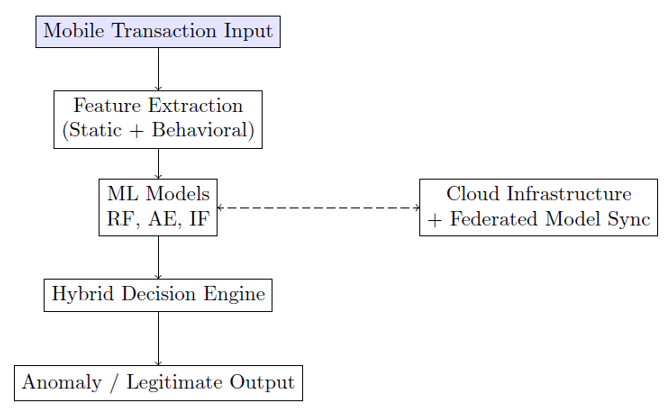
The rapid evolution of Financial Technology (FinTech) has revolutionized mobile payment systems, offering seamless, efficient, and real-time financial services. However, this digital transformation has simultaneously introduced complex cybersecurity challenges, particularly as cybercriminals increasingly exploit mobile platforms. This study proposes a novel machine learning-based framework for proactive threat detection in mobile payment environments, integrating behavioral analytics, device fingerprinting, and network anomaly detection. The framework leverages supervised and unsupervised learning models—such as Random Forest, Isolation Forest, and Autoencoders—to identify both known and zero-day threats with high precision. A hybrid feature engineering pipeline is also introduced, combining static application metadata with dynamic transaction behavior to enhance detection accuracy. Experimental results on real-world mobile payment datasets demonstrate that the proposed framework achieves superior performance in terms of precision, recall, and F1-score compared to traditional signature-based and rule-based detection systems. This research contributes to the advancement of secure FinTech ecosystems by offering a scalable and adaptive solution for real-time cyber threat mitigation in mobile payments.
visibility1,487file_download463
CrackNet: Pavement Crack Detection and Classification Based on Deep Learning Models
Research Articleslock_openOpen Access
pp. 74-84

CrackNet: Pavement Crack Detection and Classification Based on Deep Learning Models

Zubair SaeedAli Raza

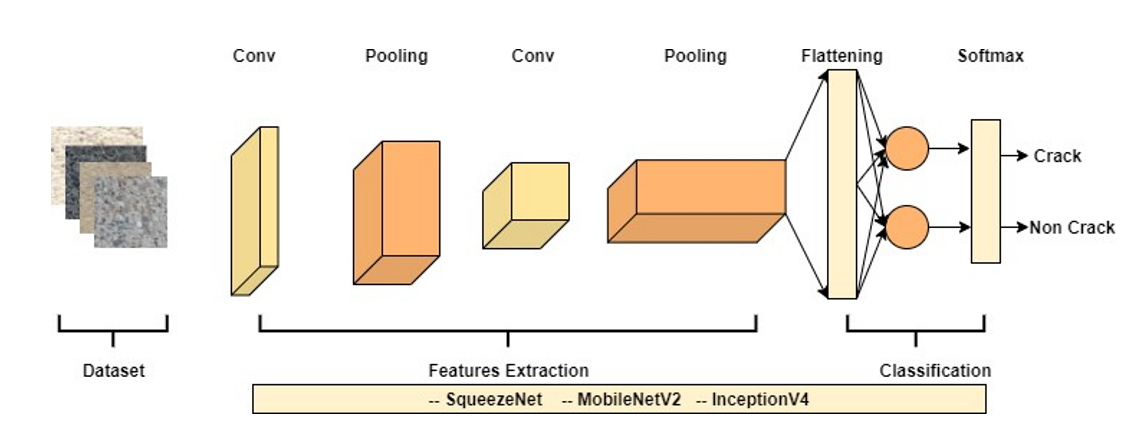
The identification of pavement cracks is essential for reducing traffic accidents and minimizing road maintenance costs. Existing crack detection methods frequently encounter challenges related to inefficiencies and accuracy, resulting in billions of dollars spent globally on road repairs annually. This study introduces an enhanced deep learning-based network aims at improving the accuracy of pavement crack detection. The proposed CrackNet utilizes advanced geometric augmentation techniques to enhance the model performance in identifying cracks across a variety of road conditions. We introduced CrackNet, a custom-designed deep-learning classification framework for pavement images. CrackNet combines pre-trained backbone feature extractors (MobileNetV2, InceptionV4, SqueezeNet) with a lightweight classifier head and a comprehensive preprocessing + augmentation pipeline to improve generalizability and address class imbalance. We evaluated three CrackNet variants (Sqz-CrackNet, Mob-CrackNet, Incep-CrackNet), each distinguished by its backbone, and found Incep-CrackNet achieved the highest accuracy of 96.05%, surpassing the Mob-crackNet and Sqz-crackNet, which attained accuracies of 95.44% and 90.06%, respectively. These findings underscore the effectiveness of the proposed deep learning framework in accurately detecting pavement cracks, representing a significant advancement over traditional detection methods.

visibility1,146file_download449
Convolutional Neural Network-Based Framework for the Detection of Tuberculosis
Research Articleslock_openOpen Access
pp. 85-91

Convolutional Neural Network-Based Framework for the Detection of Tuberculosis

Ikenna Caesar NwanduFrancisca Onyinyechi NwokomaAondowase James Orban

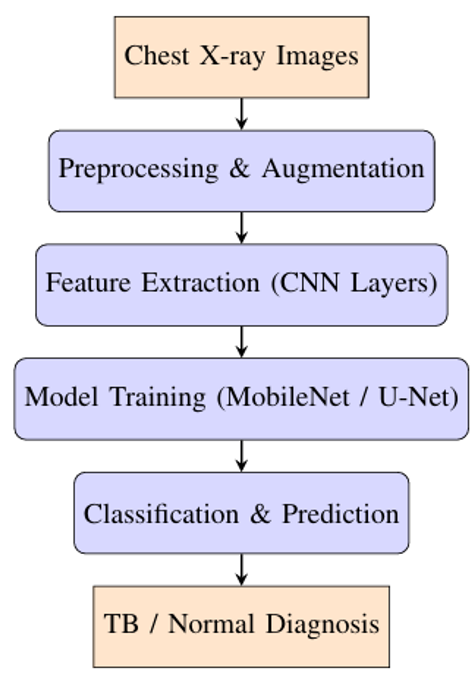
Tuberculosis (TB) remains a significant public health issue worldwide, especially in low- and middle-income countries, where access to accurate and rapid diagnostic tools is limited. Early diagnosis and treatment are essential to control spread and improve patient outcomes. Traditional TB diagnosis methods, such as sputum microscopy and culture, are time consuming and require specialized laboratory facilities. In this study, we explored the application of machine learning techniques in automating and enhancing TB detection, focusing on the analysis of chest radiograph images (X-ray). Hence, a Convolutional Neural Network-based framework is presented. The framework used advanced image preprocessing and augmentation techniques to enhance feature learning and mitigate data set imbalance to support early screening and clinical decision making. The system demonstrated high precision, correctly identifying 97% of normal chest x-rays and achieving a perfect 100% precision for TB cases, which means no false positives were recorded. In terms of recall, the model correctly detected all normal X-rays but misclassified 5% of TB cases as normal, resulting in a 95% recall for TB detection. The F1-score, which balances precision and recall, was 98% for both normal and TB cases, indicating strong classification performance. Additionally, the macro and weighted averages were both 98%, reflecting consistent and reliable model performance across different case distributions. The results indicate that the proposed CNN-based framework provides a robust, scalable, and cost-effective solution for automated TB detection, offering potential integration into computer-aided diagnostic systems.

visibility706file_download383
Digital Twin for Cryogenic Ejector Systems: Integrating Advanced Machine Learning and Dynamic Modeling
Research Articleslock_openOpen Access
pp. 92-99

Digital Twin for Cryogenic Ejector Systems: Integrating Advanced Machine Learning and Dynamic Modeling

Lotfi SnoussiOlfa FakhfakhEzzedine Nehdi

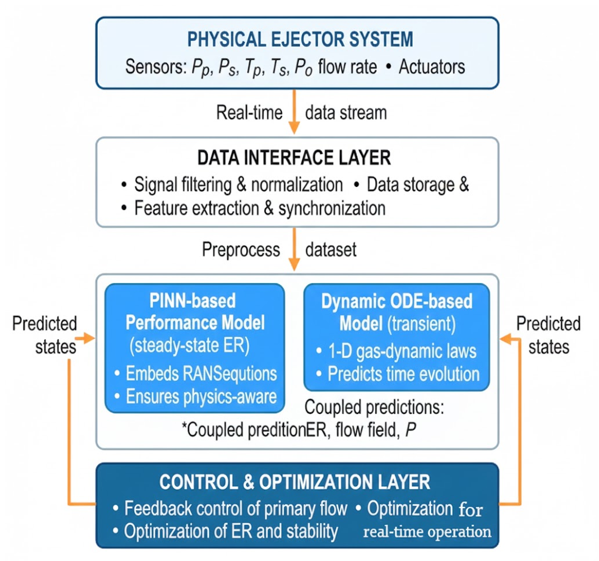
This paper presents an integrated Digital Twin (DT) framework for cryogenic ejector systems designed for Boil Off Gas (BOG) management in Liquefied Natural Gas (LNG) applications. Building on prior experimental and numerical studies, the proposed DT improves both predictive accuracy and dynamic adaptability by coupling Physics Informed Neural Networks (PINNs) with a transient dynamic model. The PINN integrates compressible flow conservation laws into its loss function, ensuring physical consistency during learning. A dataset of 1000 operating points was analyzed, revealing that the primary pressure (Pp) is the dominant factor influencing the entrainment ratio (ER). A baseline linear regression achieved an R2 equal to 0.791, while the PINN increased predictive accuracy to an R2 equal to 0.98. The dynamic model simulates the transient response of the ejector to sudden variations in BOG load, demonstrating the DT capability to anticipate system instability and enable real time control. Together, these components create a physically interpretable and computationally efficient digital framework capable of supporting the design, optimization, and operation of cryogenic ejectors. The results highlight the potential of the proposed DT to enhance energy efficiency, reliability, and safety in LNG processing systems through intelligent, physics based decision making.

visibility965file_download431
Classification of Obesity Levels Using Machine Learning Algorithms
Research Articleslock_openOpen Access
pp. 100-113

Classification of Obesity Levels Using Machine Learning Algorithms

Ahmet Can CITAKSumeyra SAHIN BAYRAMMurat KOKLU

Obesity has become a critical public health issue on a global scale due to the serious comorbidities and economic burden it brings. The aim of this study is to develop an effective machine learning model that can accurately determine obesity levels based on data including individuals' demographic characteristics and dietary habits, and to compare the performance of tree-based ensemble learning algorithms and Artificial Neural Network (ANN) approaches. In this context, classification was performed using Random Forest, XGBoost, CatBoost, and ANN (Artificial Neural Network) algorithms based on the open-source “Obesity Dataset” obtained from 1,610 participants and containing 14 different attributes. The models' performance was tested using a 5-fold cross-validation method and evaluated based on accuracy, f-score, precision, and recall using a confusion matrix. Experimental results show that tree-based ensemble models outperform the ANN approach in this dataset. The Random Forest algorithm was the most successful model with an accuracy rate of 94.34% and an F-score of 94.36, followed by XGBoost with an accuracy rate of 92.80%. In contrast, YSA remained at an accuracy rate of 82.98% and spent approximately 93 times more time in terms of training duration compared to Random Forest. When considering the obtained outputs, this study demonstrates that ensemble learning methods such as Random Forest are more efficient than ANN models in terms of both prediction accuracy and computational cost in the analysis of tabular health data, and that the developed model can be used as a reliable tool in clinical decision support systems.

visibility1,094file_download664
Deep Learning Based Classification of Real and Synthetic Animal Images
Research Articleslock_openOpen Access
pp. 114-128

Deep Learning Based Classification of Real and Synthetic Animal Images

Ibrahim AkbasOya KilciMurat Koklu

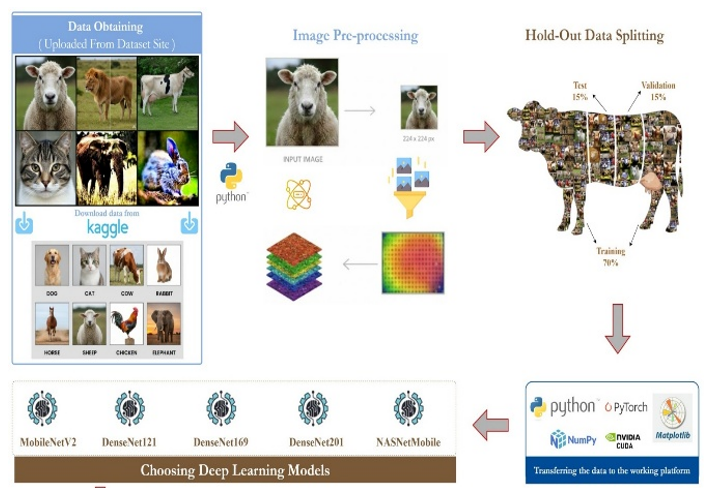
This study aims to develop a convolutional neural network (CNN)-based classification framework that can distinguish between synthetic and real animal images generated by the Stable Diffusion Turbo model. Additionally, this study will evaluate the performance of different network architectures for this task. The study employed a balanced dataset of 31,995 images, including 16,000 real images and 15,995 synthetic images generated by Stable Diffusion Turbo. The dataset includes eight animal categories: dogs, cats, cows, rabbits, horses, sheep, chickens, and elephants. All images were resized to 224 by 224 pixels, and standard preprocessing techniques were applied. During the classification stage, five pretrained convolutional neural network architectures were retrained using transfer learning, including MobileNetV2, DenseNet121, DenseNet169, DenseNet201, and NASNetMobile. Model performance was evaluated using accuracy, precision, recall, the F1 score, the area under the curve of the receiver operating characteristic, confusion matrices, and training time. The experimental results demonstrate that MobileNetV2 and DenseNet201 achieved the highest classification performance, with respective accuracy rates of 99.58% and 99.56%, and perfect area under the curve values. All DenseNet variants exhibited complete sensitivity in detecting synthetic images, whereas NASNetMobile showed substantially lower performance compared to the other models. These results suggest that synthetic images produced by diffusion-based generative models can be reliably identified when appropriately designed CNN architectures and balanced datasets are used. This provides a significant methodological contribution to the discrimination of synthetic versus real images, the detection of fake content, and the verification of visual authenticity.

visibility1,042file_download401