Fusion-Aware Lightweight CNN with Channel-Wise Attention for Rose Leaf Disease Classification in Multispectral Color Domains
- Publication Date
- August 31, 2025
- Volume / Issue
- Vol. 4, Issue 2 (pp. 15-21)
- DOI Identifier
- 10.58190/imiens.2025.123
Fusion-Aware Lightweight CNN with Channel-Wise Attention for Rose Leaf Disease Classification in Multispectral Color Domains
Official publication asset for Intelligent Methods In Engineering Sciences
subjectAbstract
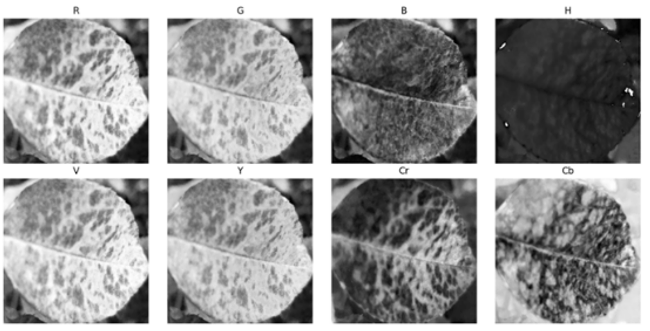
The rose plant holds significant economic and cultural value, not only as an ornamental species but also due to its widespread use across various industrial domains such as cosmetics, medicine, and perfumery. In this context, the early and accurate detection of leaf diseases is crucial for ensuring the healthy cultivation of rose plants. This study presents a novel approach that integrates image processing and deep learning techniques for the detection of common leaf diseases in rose plants. The proposed method utilizes the RoseNet dataset, which consists of three classes: Black Spot, Downy Mildew, and Fresh Leaf. Input images were converted into RGB, HSV, and YCrCb color spaces and then fused at the channel level to enhance spectral diversity and improve the model's learning capacity. The developed convolutional neural network (CNN) architecture was enriched with channel attention mechanisms, namely Squeeze-and-Excitation (SE) and Efficient Channel Attention (ECA) blocks. Class imbalance issues were addressed through class weighting and label smoothing strategies. The model's performance was evaluated using multiple metrics such as accuracy, precision, recall, and F1-score. Achieving an accuracy of 95.65%, the proposed model outperformed widely used CNN architectures in the literature. Furthermore, with a low parameter count (1.03M) and a fast test time (376 ms), the model is well-suited for deployment on embedded systems. The findings demonstrate that attention mechanisms are effective in enhancing class discrimination, particularly in low-sample-size datasets. Thus, the proposed model offers a reliable, cost-effective, and AI-based solution for the diagnosis of plant leaf diseases.
Author Information & Affiliations
- Yusuf Yaman— Selçuk University, Faculty of Technology, Department of Electrical and Electronics Engineering, Konya, Türkiye linkhttps://orcid.org/0009-0008-7855-1626
- Esra Kaya— Selçuk University, Faculty of Technology, Department of Electrical and Electronics Engineering, Division of Circuits and Systems, Konya, Türkiyelinkhttps://orcid.org/0000-0003-1401-9071
format_list_numberedReferences (14)
Cited Literature- 1
Mohanty, S. P., Hughes, D. P., & Salathé, M., "Using deep learning for image-based plant disease detection," Frontiers in Plant Science, vol. 7, p. 1419, 2016. DOI: 10.3389/fpls.2016.01419
- 2
Ferentinos, K. P., "Deep learning models for plant disease detection and diagnosis," Computers and Electronics in Agriculture, vol. 145, pp. 311–318, 2018. DOI: 10.1016/j.compag.2018.01.009
- 3
Sankaran, S., Mishra, A., Ehsani, R., & Davis, C., "A review of advanced techniques for detecting plant diseases," Computers and Electronics in Agriculture, vol. 72, no. 1, pp. 1–13, 2010. DOI: 10.1016/j.compag.2010.02.007
- 4
Kamilaris, A., & Prenafeta-Boldú, F. X., "Deep learning in agriculture: A survey," Computers and Electronics in Agriculture, vol. 147, pp. 70–90, 2018. DOI: 10.1016/j.compag.2018.02.016
- 5
Ali, I., Zhu, C., & Zhou, M., "Plant disease identification using deep learning: A review," Plants, vol. 10, no. 10, p. 2123, 2021. DOI: 10.3390/plants10102123
- 6
Too, E. C., Yujian, L., Njuki, S., & Yingchun, L., "A comparative study of fine-tuning deep learning models for plant disease identification," Computers and Electronics in Agriculture, vol. 161, pp. 272–279, 2019. DOI: 10.1016/j.compag.2018.03.032
- 7
Fuentes, A., Yoon, S., Kim, S., & Park, D. S., "A robust deep-learning-based detector for real-time tomato plant diseases and pests recognition," Sensors, vol. 17, no. 9, p. 2022, 2017. DOI: 10.3390/s17092022
- 8
Arivazhagan, S., Shebiah, R. N., et al., "Detection of unhealthy region of plant leaves and classification of plant leaf diseases using texture features," CIGR Journal, vol. 15, no. 1, pp. 211–217, 2013.
- 9
M. Ali-Alvy, G. K. Khan, M. J. Alam, S. Islam, M. Rahman, and M. S. Rahman, "Rose Plant Disease Detection using Deep Learning," in Proc. 2023 7th Int. Conf. on Trends in Electronics and Informatics (ICOEI), Tirunelveli, India, 2023, pp. 1244–1249. DOI: 10.1109/ICOEI56765.2023.10126031
- 10
Basak, Shuvo, Unveiling the Enigma: Advancing Rose Leaf Disease Detection with Transformed Images and Convolutional Neural Networks, 2025. DOI: 10.5281/zenodo.8111573
- 11
Nabilah, L., Nisar, N., Amnah, A., & Arfida, S., "Enhancing Rose Leaf Disease Detection Accuracy Using Optimized CNN Parameters," Bulletin of Computer Science and Electrical Engineering, vol. 4, no. 2, pp. 83–88, 2024. DOI: 10.25008/bcsee.v4i2.1184
- 12
Mridha, M. F., Alfarhood, S., Rahman, M. M., Alam, T., & Uddin, M. N., "Transforming leaf disease diagnosis through deep transfer learning: An Xception-based approach," Plant Direct, vol. 9, no. 6, p. e1505857, 2025. DOI: 10.1002/pld3.1505857
- 13
Rajbongshi, A., Sarker, T., Ahamad, M., & Rahman, M., "Rose Diseases Recognition using MobileNet," in Proc. ISMSIT, pp. 1–7, 2020. DOI: 10.1109/ISMSIT50672.2020.9254420
- 14
Hu, J., Shen, L., & Sun, G., "Squeeze-and-Excitation Networks," in Proc. IEEE Conf. on Computer Vision and Pattern Recognition (CVPR), pp. 7132–7141, 2018. DOI: 10.1109/CVPR.2018.00745