Motor Imagery BCI Classification with Frequency and Time-Frequency Features by Using Different Dimensions of the Feature Space Using Autoencoders
- Publication Date
- October 7, 2022
- Volume / Issue
- Vol. 1, Issue 1 (pp. 8-12)
- DOI Identifier
- 10.58190/imiens.2022.2
Motor Imagery BCI Classification with Frequency and Time-Frequency Features by Using Different Dimensions of the Feature Space Using Autoencoders
Official publication asset for Intelligent Methods In Engineering Sciences
subjectAbstract
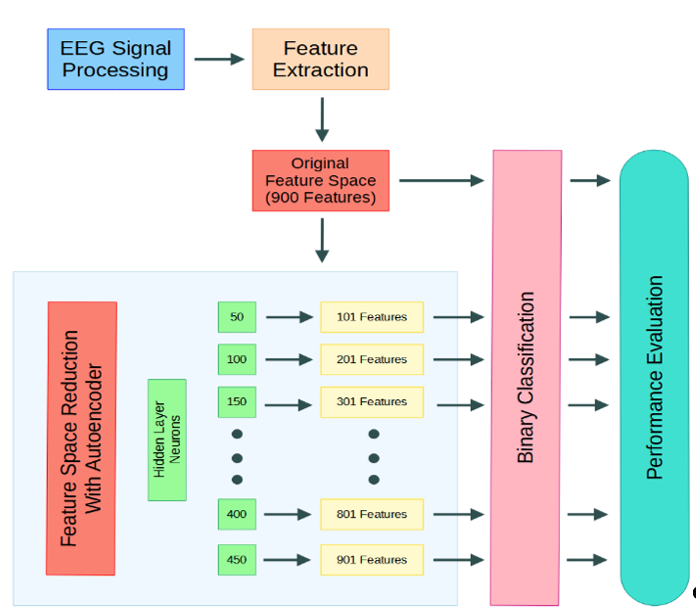
Brain-Computer Interfaces (BCIs) enable the users to directly communicate with machines based on various desired purposes through brain signals without moving any body parts. Thus, they have become very useful for prostheses, electric wheelchairs, virtual keyboards, and other studies like survey applications and emotion classifications. In this study, EEG signal processing was performed on the BCI Competition III-3a dataset, which contains motor imagery (MI) signals with four classes. Features of the non-stationary EEG signals belonging to three subjects were extracted using Power Spectral Density (PSD) with welch method, Wavelet Decomposition (WD), Empirical Mode Decomposition (EMD) and Hilbert-Huang Transform (HHT). From extracted 900 features, feature space dimension reduction was realized using Autoencoder, an unsupervised learning algorithm. The average accuracy obtained with Artificial Neural Network (ANN) is 74.5% for all binary classifications, which is generally a good result because of the non-stationary nature of EEG signals. 801 features yielded the best classification performance, obtained using an autoencoder with 400 hidden layer neurons.
Author Information & Affiliations
- Esra Kaya— Selcuk University, Faculty of Technology, Electrical and Electronics Engineering, Konya, Turkiyelinkhttps://orcid.org/0000-0003-1401-9071
- Ismail Saritas— Selcuk University, Faculty of Technology, Electrical and Electronics Engineering, Konya, Turkiyelinkhttps://orcid.org/0000-0002-5743-4593
format_list_numberedReferences (20)
Cited Literature- 1
M. Hämäläinen, R. Hari, R. J. Ilmoniemi, J. Knuutila, and O. V. Lounasmaa, "Magnetoencephalography—theory, instrumentation, and applications to noninvasive studies of the working human brain," Reviews of modern Physics, vol. 65, no. 2, p. 413, 1993.
- 2
R. Srinivasan, "Methods to improve the spatial resolution of EEG," International journal of bioelectromagnetism, vol. 1, no. 1, pp. 102-111, 1999.
- 3
P. M. Vespa, V. Nenov, and M. R. Nuwer, "Continuous EEG monitoring in the intensive care unit: early findings and clinical efficacy," Journal of Clinical Neurophysiology, vol. 16, no. 1, pp. 1-13, 1999.
- 4
F. Yasuno et al., "The PET radioligand [11 C] MePPEP binds reversibly and with high specific signal to cannabinoid CB 1 receptors in nonhuman primate brain," Neuropsychopharmacology, vol. 33, no. 2, pp. 259-269, 2008.
- 5
J. Decety and D. H. Ingvar, "Brain structures participating in mental simulation of motor behavior: A neuropsychological interpretation," Acta psychologica, vol. 73, no. 1, pp. 13-34, 1990.
- 6
A. S. Royer, A. J. Doud, M. L. Rose, and B. He, "EEG control of a virtual helicopter in 3-dimensional space using intelligent control strategies," IEEE Transactions on neural systems and rehabilitation engineering, vol. 18, no. 6, pp. 581-589, 2010.
- 7
S. Bhattacharyya, M. Pal, A. Konar, and D. Tibarewala, "An interval type-2 fuzzy approach for real-time EEG-based control of wrist and finger movement," Biomedical Signal Processing and Control, vol. 21, pp. 90-98, 2015.
- 8
K. K. Ang and C. Guan, "EEG-based strategies to detect motor imagery for control and rehabilitation," IEEE Transactions on Neural Systems and Rehabilitation Engineering, vol. 25, no. 4, pp. 392-401, 2016.
- 9
R. Mahajan and D. Bansal, "Real time EEG based cognitive brain computer interface for control applications via Arduino interfacing," Procedia computer science, vol. 115, pp. 812-820, 2017.
- 10
K. S. Mistry, P. Pelayo, D. G. Anil, and K. George, "An SSVEP based brain computer interface system to control electric wheelchairs," in 2018 IEEE International Instrumentation and Measurement Technology Conference (I2MTC), 2018: IEEE, pp. 1-6.
- 11
M. Athif and H. Ren, "WaveCSP: a robust motor imagery classifier for consumer EEG devices," Australasian physical & engineering sciences in medicine, vol. 42, no. 1, pp. 159-168, 2019, doi: https://doi.org/10.1007/s13246-019-00721-0.
- 12
C.-C. Fan, H. Yang, Z.-G. Hou, Z.-L. Ni, S. Chen, and Z. Fang, "Bilinear neural network with 3-D attention for brain decoding of motor imagery movements from the human EEG," Cognitive Neurodynamics, vol. 15, no. 1, pp. 181-189, 2021, doi: https://doi.org/10.1007/s11571-020-09649-8.
- 13
R. Xiao, Y. Huang, R. Xu, B. Wang, X. Wang, and J. Jin, "Coefficient-of-variation-based channel selection with a new testing framework for MI-based BCI," Cognitive Neurodynamics, vol. 16, no. 4, pp. 791-803, 2022, doi: https://doi.org/10.1007/s11571-021-09752-4.
- 14
A. Ng, "Sparse autoencoder," CS294A Lecture notes, vol. 72, no. 2011, pp. 1-19, 2011.
- 15
A. Schlögl, G. Müller, R. Scherer, and G. Pfurtscheller, "BIOSIG-an Open Source Software Package for biomedical Signal Processing," in 2nd OpenECG Workshop, 2004: . pp. 77-78.
- 16
B. Blankertz et al., "Bci competition iii," Fraunhofer FIRST. IDA, http://ida. first. fraunhofer. de/projects/bci/competition_iii, 2005.
- 17
S. Villwock and M. Pacas, "Application of the Welch-method for the identification of two-and three-mass-systems," IEEE Transactions on Industrial Electronics, vol. 55, no. 1, pp. 457-466, 2008.
- 18
R. Choudhary, S. Mahesh, J. Paliwal, and D. Jayas, "Identification of wheat classes using wavelet features from near infrared hyperspectral images of bulk samples," Biosystems Engineering, vol. 102, no. 2, pp. 115-127, 2009.
- 19
G. Rilling, P. Flandrin, and P. Goncalves, "On empirical mode decomposition and its algorithms," in IEEE-EURASIP workshop on nonlinear signal and image processing, 2003, vol. 3, no. 3: Citeseer, pp. 8-11.
- 20
N. E. Huang and Z. Wu, "A review on Hilbert‐Huang transform: Method and its applications to geophysical studies," Reviews of geophysics, vol. 46, no. 2, 2008.